 |
| While the keg fills, I take a sip of my Dole-bludger's Draught. |
Saturday, December 29, 2012
Pinko's English Mild Ale
After my Dole-bludger's Draught, I decided to make a richer, more complex beer. So, a few weeks ago, I picked up two can's of Black Rock's IPA and augmented this base with a caramalt grain pack, a kilo of dextrose and two types of hops. Feeling that the kits are usually bitter enough, I used the Styrian Goldings hops mainly for general "hoppiness"; these were added at 30 minutes prior to the end of the boil. And for aroma, I used Fuggles hops. (These were added within about 5 minutes of concluding the boil. This raw beer smells and tastes great. It is hoppy and caramel. You should be able to enjoy it all afternoon as, in the style of an English Mild, the alcohol by volume is only about 3.5 - 4.0%.

Sunday, June 14, 2009
FINALLY, a new Redbox brew
Well on the brewing front have been very slack and need to thank Pinko and Jen for keeping at me to put on a new brew especially after the puchase of 10kg of malt. So on Sunday, Pinko and Roberts dropped by to give encouragement and a hand in starting of a new brew. Thanks to Pinko for loan of the pot and grain bag.
The aim was loosely based around a pale ale recipe and after filling the house with great smell of malt and hops looking forward to the finished product. The recipe for this brew was fairly basic, will comment on the taste when trialled in about 4-5weeks. The specific gravity started at around 1.042, so should finish with a beer with around 4.4-4.5% alcohol.
June Pale ale
3kg malt
180g Cascade hops (60 added at start, 60 at 30mins and 60 for final few minutes)
150-200g cracked grain
S-05 Safale yeast (american style ale yeast)
The aim was loosely based around a pale ale recipe and after filling the house with great smell of malt and hops looking forward to the finished product. The recipe for this brew was fairly basic, will comment on the taste when trialled in about 4-5weeks. The specific gravity started at around 1.042, so should finish with a beer with around 4.4-4.5% alcohol.
June Pale ale
3kg malt
180g Cascade hops (60 added at start, 60 at 30mins and 60 for final few minutes)
150-200g cracked grain
S-05 Safale yeast (american style ale yeast)
Wednesday, April 8, 2009
Fox Grande Reserve
My Blue-label Chimay-style brew, the Fox Grande Reserve, requires almost 8kg of light dry malt extract. I incrementally add malt to my new 20L brew-pot and weigh it using bathroom scales. This process is conducted outside now. The malt is a fine powder and wherever it lands, you may end up with a sticky, (probably tasty) surface.
My helpful assistant stirs the pot. Full power from the biggest element brings the pot to the boil. After this point, a rolling boil is maintained using 45% power.
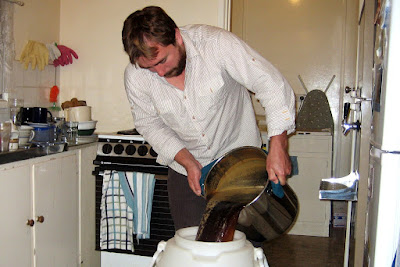
Having removed the grain bag with its contents of spent chocolate malt and fuggles hops, I pour the contents of the pot into my 60L fermenter with a few ice-cubes and supplement the liquid with tap water to generate a total volume of 50L.
Having pitched the K-97 wheat-beer yeast, Jen inserts the airlock. This is one of our most elaborate brews; It incorporates almost a kilogram of honey and one-and-a-half kilograms of brown sugar. Thankfully, we are able to prepare this brew on a grand scale. With a carton of blue-label Chimay retailing at over $200 per case of 12 x 750mL longnecks,1 this brew represents over $1000 worth of high-quality hand-crafted beer!
 |
| From Chimay |
My helpful assistant stirs the pot. Full power from the biggest element brings the pot to the boil. After this point, a rolling boil is maintained using 45% power.
 |
| From Chimay |
Having removed the grain bag with its contents of spent chocolate malt and fuggles hops, I pour the contents of the pot into my 60L fermenter with a few ice-cubes and supplement the liquid with tap water to generate a total volume of 50L.
 |
| From Chimay |
Having pitched the K-97 wheat-beer yeast, Jen inserts the airlock. This is one of our most elaborate brews; It incorporates almost a kilogram of honey and one-and-a-half kilograms of brown sugar. Thankfully, we are able to prepare this brew on a grand scale. With a carton of blue-label Chimay retailing at over $200 per case of 12 x 750mL longnecks,1 this brew represents over $1000 worth of high-quality hand-crafted beer!
 |
| From Chimay |
Wednesday, April 1, 2009
A big boy
Jen presented me with a 20L stock pot in which I concocted my first double-batch of beer. For 50L of beer, I used 6kg of light dry malt, 150g crystal grain, 100g chocolate grain, 130g Fuggles hops and S-04 Safale yeast. Cost-wise, that's $42 + $1.50 + $0.65 + $6.80 + $3.75 + $2 postage = $56.70. This equates to a cost of about $11 per case of beer.
Most of the components of this brew were acquired from Jayne Lynn from BettABrew Beer & Wine Making Supplies in Parkwood, Queensland. Jayne offered me a better deal on the postage if I purchased materials in bulk. As such, I placed a joint order on behalf of Phil, Mix, Jen and I. Here's what we received:
$280.00 : 2 x 20 kg light dry malt extract
$26.00 : 1 x 500 g cascade hop plugs
$23.50 : 1 x 450 g fuggles hop plugs
$59.00 : 1 x HDPE 60 litre fermenter, bung and airlock
$11.85 : 3 x Saflager S23 yeast
$11.25 : 3 x Safale S-04 yeast
$7.90 : 2 x Saflager W-34/70 yeast
$15.00 : postage
-------
$434.50 : total
-------
I recall now that I will need an adhesive thermometer and another tap but Big W will likely satisfy these requirements.
Most of the components of this brew were acquired from Jayne Lynn from BettABrew Beer & Wine Making Supplies in Parkwood, Queensland. Jayne offered me a better deal on the postage if I purchased materials in bulk. As such, I placed a joint order on behalf of Phil, Mix, Jen and I. Here's what we received:
$280.00 : 2 x 20 kg light dry malt extract
$26.00 : 1 x 500 g cascade hop plugs
$23.50 : 1 x 450 g fuggles hop plugs
$59.00 : 1 x HDPE 60 litre fermenter, bung and airlock
$11.85 : 3 x Saflager S23 yeast
$11.25 : 3 x Safale S-04 yeast
$7.90 : 2 x Saflager W-34/70 yeast
$15.00 : postage
-------
$434.50 : total
-------
I recall now that I will need an adhesive thermometer and another tap but Big W will likely satisfy these requirements.
Sunday, January 4, 2009
A month without brew so making something special to celebrate
Well after a huge new years and a couple of resolutions of a reduction of beer and alcohol intake, this means the month of January bar the Australia Day weekendis to be dry (already think this will be a struggle.
I have decided on a Summer brew that is meant to be similar to Little Creatures Pale Ale, the basic recipe came from the Malthouse site. This recipe should provide a nice drop and my first venture into some more complex brewing rather than relying solely on a kit, this will be the first brew for the MC residence and should be rather good by the pool and on the beach, according to Pinko this beer should provide a nice malty beer with a good hoppy taste, the recipe is
ESB Pale Ale
Dried Light Malt 1kg
Crystal Malt Grain 150g
Chinook 25g & Cascade Hops 25g
Safale Yeast
Hope all had a good New Years and Happy brewing!
I have decided on a Summer brew that is meant to be similar to Little Creatures Pale Ale, the basic recipe came from the Malthouse site. This recipe should provide a nice drop and my first venture into some more complex brewing rather than relying solely on a kit, this will be the first brew for the MC residence and should be rather good by the pool and on the beach, according to Pinko this beer should provide a nice malty beer with a good hoppy taste, the recipe is
ESB Pale Ale
Dried Light Malt 1kg
Crystal Malt Grain 150g
Chinook 25g & Cascade Hops 25g
Safale Yeast
Hope all had a good New Years and Happy brewing!
Wednesday, December 10, 2008
Fun Ale
Brew 82 used only about 200g of cracked crystal grain; It was sufficient to impart that delicious red colour. It's a lager base fermented with an ale yeast. There's a spot of roasted "Joe White", some cracked coriander and squirt of licorice extract.
Clownie and I just can't resist this brew! Next up will be a "bare-bones" lager more suited to consumption on a vast scale. Of brew 82, you take a little bit every day.
 |
| From Beer |
Clownie and I just can't resist this brew! Next up will be a "bare-bones" lager more suited to consumption on a vast scale. Of brew 82, you take a little bit every day.
Back at it
G'Day All,
Sorry about not posting anything in the past couple of months, as the kegs have been pretty full for the past couple of months, there hasn't been much need of doing too much about it. Last month I did an elcheepo double batch with a couple of tins of mud, 2 brew enhancers and another bag of sugar. Dave, Jen, Mixy and Roberts sampled this brew which was ok, as it did the job, but Dave and Jen both put their finger on what it was missing.........bitterness. Due to the large sugar levels that had been put into the batch to increase the alcohol levels, and on my behalf I was doing it on the cheap, I didn't worry about hopping the beer. But apart from that, the beers were flowing and were enjoyed by all.
The latest batch that I have kegged up in preparations for Friday evening and after the garage has been decked out completly with a table made of wood (opposed to the cardboard boxes that we have used), and a couple of lounges have also gone in and a tv to boot, is the Country Brewer's recipe of Goin' Fishin'. It is a bitter with 1kg of booster, 500g of light booster, 150g crystal grain and hersbrucker hops. I was impredded with the colour and the smell when I kegged it today and I am will be enjoyed on Friday evening.
The latest brew I am doing is another double batch to keep the kegs topped up, especially over the festive season. This isn't a specific recipe but just flavours that I was keen on at the time of purchase.
2 x Morgan's Blue Mountain Lager
1kg Light Malt
1.6kg Dextrose
0.4kg Maltodextrin
24g Hallertau Hops
I think it will be a pretty good brew and look forward to sharing a few around.
Sorry about not posting anything in the past couple of months, as the kegs have been pretty full for the past couple of months, there hasn't been much need of doing too much about it. Last month I did an elcheepo double batch with a couple of tins of mud, 2 brew enhancers and another bag of sugar. Dave, Jen, Mixy and Roberts sampled this brew which was ok, as it did the job, but Dave and Jen both put their finger on what it was missing.........bitterness. Due to the large sugar levels that had been put into the batch to increase the alcohol levels, and on my behalf I was doing it on the cheap, I didn't worry about hopping the beer. But apart from that, the beers were flowing and were enjoyed by all.
The latest batch that I have kegged up in preparations for Friday evening and after the garage has been decked out completly with a table made of wood (opposed to the cardboard boxes that we have used), and a couple of lounges have also gone in and a tv to boot, is the Country Brewer's recipe of Goin' Fishin'. It is a bitter with 1kg of booster, 500g of light booster, 150g crystal grain and hersbrucker hops. I was impredded with the colour and the smell when I kegged it today and I am will be enjoyed on Friday evening.
The latest brew I am doing is another double batch to keep the kegs topped up, especially over the festive season. This isn't a specific recipe but just flavours that I was keen on at the time of purchase.
2 x Morgan's Blue Mountain Lager
1kg Light Malt
1.6kg Dextrose
0.4kg Maltodextrin
24g Hallertau Hops
I think it will be a pretty good brew and look forward to sharing a few around.
Sunday, December 7, 2008
A summer brew?
Hi All,
Well after having a few people over have drank all of our homebrew, Ginger beer and Wheat beer,its time to clean some botttles and put on a couple of new brews Looking for recommendations, suggestions and recipes for a couple of brews that are good for the hot weather, by the pool and the beach.
Cheers and hope the brewings all going well, especially in this time of sun where beer seems to disappear alot quicker
Cheers
Well after having a few people over have drank all of our homebrew, Ginger beer and Wheat beer,its time to clean some botttles and put on a couple of new brews Looking for recommendations, suggestions and recipes for a couple of brews that are good for the hot weather, by the pool and the beach.
Cheers and hope the brewings all going well, especially in this time of sun where beer seems to disappear alot quicker
Cheers
Thursday, November 20, 2008
Ginger Beer, a success
The Redbox ginger beer made from the Coopers mix was the final brew for the Bruce brewery with the brewery relocating to the city. This brew we had a couple of small problems with the yeast not starting, a lazy bottler the brew sat in the vat for over 3 weeks and the seal on the vat may of been a little dodgy. Due to impatience and the desire for ginger beer the first bottle was cracked 2 weeks after botttling, and we wait with baited breath to see if this met our lofty standards. We were all very satisfied and I may say the head brewer was quietly surprised due to the earlier issues and knowing that sometimes homebrew can be a fickle beast. So now we have a nice ginger beer, which has quite a nice little bite and just in time for summer. I think the next brew will be an amber or golden ale style beer, probably brewed after house guests consuming all of our wheat beer.
Saturday, November 15, 2008
Elise's Spiteful Tongue
My lime and chilli beer, dubbed Elise's Spiteful Tongue, (other possible names were the Cold Englishman and the Fruity Tingle) is a stunning success! I made the beer with the juice of two limes added to the wort. When I bottled the beer I added a small chilli to half of the bottles. The result - the beers with chilli have a definate spice tingle and is not for the faint hearted somewhat overshadowing the tinge of lime. The limey beers without chilli have a light and fresh quality along with the lime overtones. A friend even likened it to cidar. As shown in the recipe below I used a mexican lager kit as I was hoping to attain a similar easy, light brew to corona, thus maximising the influence of the lime and chilli flavours
Personally I think my summer is complete. I will try a similar brew in the next few months, but with different sized chillies and observe the difference.
Recipe
Black Rock Mexican Lager
500g Dry light malt
500g Dextrose
Juice of 2 limes squeezed
Small red chillis
4.6% Alcohol
Notes:
- The chillis need to be sterilised. I used Scotch Whiskey (most strong spirits should be fine)
- You can add the chillis to the primary fermenter if you wish, but adding them to the bottle allows the production of non-spicy beer too, in case you fellow beer conniseurs do not enjoy spice.
- I've been told the size of a chilli is directly related to its spiciness the smaller the chilli the spicier it is. Keep this in mind when choosing chillis. Green chillies are much hotter than red chillies.
Personally I think my summer is complete. I will try a similar brew in the next few months, but with different sized chillies and observe the difference.
Recipe
Black Rock Mexican Lager
500g Dry light malt
500g Dextrose
Juice of 2 limes squeezed
Small red chillis
4.6% Alcohol
Notes:
- The chillis need to be sterilised. I used Scotch Whiskey (most strong spirits should be fine)
- You can add the chillis to the primary fermenter if you wish, but adding them to the bottle allows the production of non-spicy beer too, in case you fellow beer conniseurs do not enjoy spice.
- I've been told the size of a chilli is directly related to its spiciness the smaller the chilli the spicier it is. Keep this in mind when choosing chillis. Green chillies are much hotter than red chillies.
Saturday, November 8, 2008
Powdered Corn Syrup
Pinko wrote an article on Hydrolized corn products. Here is the product I have bought, and it will find its way into a brew soon.  'Powdered Corn Syrup' improves texture and mouthfeel (so it claims). Its is soluble and has 'low sweetness', hence it shouldn't affect the taste of the beer. Is this true? Only time will tell...
'Powdered Corn Syrup' improves texture and mouthfeel (so it claims). Its is soluble and has 'low sweetness', hence it shouldn't affect the taste of the beer. Is this true? Only time will tell...
Monday, October 27, 2008
Fox Place Brew 80: Lager
A "yeast-starter" was produced from the tailings of the previous lager brewed at The Fox and was pitched into brew 80. Despite the weather having turned cool last week, this lager strain was again a steady performer. A graphical representation of the course of the fermentation is shown below.

The original and final density readings of this brew were 1039 and 1007 g/L, respectively. These reading correspond to an alcohol concentration in brew 80 of approximately 5.1 % (v/v), or 1.7 standard drinks per schooner.
Fox Place Brew 78: Cider
Brew 78 was kegged after brew 79 because of this cider's lengthy fermentation. Our experience has been that relatively nutrient-poor brews such as ciders and ginger beers undergo a slower fermentation that a malt beer. This effect may have been exacerbated by a lack of external heating in this instance. The development of this cider during fermentation is shown graphically below.

The Black Rock "Cider" kit was augmented with dextrose (1kg) and produced a wort with a density of 1034g/L. The final density was 1000g/L and equates to an alcohol concentration of approximately 4.4% (v/v). This brew is currently being force-carbonated and I intend to report back with some details of the finished product.
Monday, October 20, 2008
Hydrolyzed corn products in brewing
Phil was considering using corn syrup as a brewing adjunct. Corn is a cheap source of starch and from it a range of hydrolyzed products can be obtained. To avoid confusion, I consider it useful to briefly describe to use of corn derivatives in homebrewing. As an introduction, I will mention the processing of barley required prior to brewing.
A grain of barley is largely an energy source for the germinated seedling that it will nurture. The energy in a grain of barley is stored mostly as starch. Starch (polysaccharides) must be cleaved into smaller units such as maltose (a disaccharide) by enzymes in the germinated grain to make useful fuel. Enzymes from within the grain perform this function when barley is warm and moist. Artificially raising the temperature after germination speeds up enzyme activity and is called "malting". The malting process converts most of the tasteless starch into sweet maltose.
Barley is easily malted because it is rich in those enzymes that hydrolyze starch and generate maltose and some other dextrins. The enzymes from barley are sufficiently active that additional sources of starch such as corn or potatoes may be added to a mash containing barley. The barley enzymes will go work on corn starch and potato starch thereby generating extra fermentable sugars.
The use of starch derived from sources other than barley has become entrenched in brewing. The use of corn or rice in brewing tends to generate a beer with less body and flavour than its all-malt brother. Most of the commercial beer kits in Australia are made from malted barley and, to a lesser extent, wheat. Adding corn or potato starch when making up your wort will be ineffectual as active enzymes will not be available to hydrolyze starch. (The starch will harmlessly silt out in your fermenter).
To replicate those beers which may have incorporated corn, or simply to be economical, a variety of hydrolysed starches are available. These products are prepared via the controlled action of acids and/or enzymes on corn (or wheat or potato) starch. If partial hydrolysis has taken place, the starch will have been converted into an assortment of dextrins (oligosaccharides). Complete hydrolysis of the starch will yield dextrose (the monomer of corn starch).
Those dextrins derived from corn are called maltodextrin or corn syrup solids. These oligosaccharides are, unlike starch, soluble in water. However, they are mostly inaccessible to yeast as a food source; thus maltodextrin adds body to a beer (suggestively described as "mouth feel") and little else. Although yeast cannot access maltodextrin as a food source, you can! In this way maltodextrin can add a little to your body too.
Dextrose (also called corn syrup or glucose) is also soluble in water but is readily and completely digested by yeast. This monosaccharide increases the alcohol concentration of the brew as it is consumed. As alcohol is less dense than water, simple sugar adjuncts such as dextrose also effect a thinning of the beer. Likely, this is why dextrose and maltodextrin are often used in conjunction with each other.
A grain of barley is largely an energy source for the germinated seedling that it will nurture. The energy in a grain of barley is stored mostly as starch. Starch (polysaccharides) must be cleaved into smaller units such as maltose (a disaccharide) by enzymes in the germinated grain to make useful fuel. Enzymes from within the grain perform this function when barley is warm and moist. Artificially raising the temperature after germination speeds up enzyme activity and is called "malting". The malting process converts most of the tasteless starch into sweet maltose.
Barley is easily malted because it is rich in those enzymes that hydrolyze starch and generate maltose and some other dextrins. The enzymes from barley are sufficiently active that additional sources of starch such as corn or potatoes may be added to a mash containing barley. The barley enzymes will go work on corn starch and potato starch thereby generating extra fermentable sugars.
The use of starch derived from sources other than barley has become entrenched in brewing. The use of corn or rice in brewing tends to generate a beer with less body and flavour than its all-malt brother. Most of the commercial beer kits in Australia are made from malted barley and, to a lesser extent, wheat. Adding corn or potato starch when making up your wort will be ineffectual as active enzymes will not be available to hydrolyze starch. (The starch will harmlessly silt out in your fermenter).
To replicate those beers which may have incorporated corn, or simply to be economical, a variety of hydrolysed starches are available. These products are prepared via the controlled action of acids and/or enzymes on corn (or wheat or potato) starch. If partial hydrolysis has taken place, the starch will have been converted into an assortment of dextrins (oligosaccharides). Complete hydrolysis of the starch will yield dextrose (the monomer of corn starch).
Those dextrins derived from corn are called maltodextrin or corn syrup solids. These oligosaccharides are, unlike starch, soluble in water. However, they are mostly inaccessible to yeast as a food source; thus maltodextrin adds body to a beer (suggestively described as "mouth feel") and little else. Although yeast cannot access maltodextrin as a food source, you can! In this way maltodextrin can add a little to your body too.
Dextrose (also called corn syrup or glucose) is also soluble in water but is readily and completely digested by yeast. This monosaccharide increases the alcohol concentration of the brew as it is consumed. As alcohol is less dense than water, simple sugar adjuncts such as dextrose also effect a thinning of the beer. Likely, this is why dextrose and maltodextrin are often used in conjunction with each other.
Thursday, October 16, 2008
Washing Bottles, Not lucky enough to own a keg system.
Well after stuffing around for ages finally got around to washing out bottles which probably has to be the most tedious part of brewing, apart from waiting for it being ready to drink.
The things i have found here are that you can never scrub as hard and fast as you want especially if the bottles are hot from the water being added. So to overcome this problem get a good quality bottle bruch and chop the wired top so that has no handle and attach to a power drill, preferable keyless chuck drill with multiple settings. This prove a highly effective and through way of ensuring that the bottles get cleaned on all surfaces.
Second ensure the bottle brush bristles don't melt! This happened with the new brush purchased recently when had almost boiling water in bottles to sterilise, place brush in bottles and removed and bristles had shrunk to half the size. Not sure if this was type of brush that was purchased as old bottle brush never had this problem.
Anyway now to wait a month or so and will have a batch ready to go.
The things i have found here are that you can never scrub as hard and fast as you want especially if the bottles are hot from the water being added. So to overcome this problem get a good quality bottle bruch and chop the wired top so that has no handle and attach to a power drill, preferable keyless chuck drill with multiple settings. This prove a highly effective and through way of ensuring that the bottles get cleaned on all surfaces.
Second ensure the bottle brush bristles don't melt! This happened with the new brush purchased recently when had almost boiling water in bottles to sterilise, place brush in bottles and removed and bristles had shrunk to half the size. Not sure if this was type of brush that was purchased as old bottle brush never had this problem.
Anyway now to wait a month or so and will have a batch ready to go.
Monday, October 13, 2008
Fox Place Brew 79
All kegs were, until this morning, empty at the Fox. This called for immediate action. I am shown below shaking a keg sterile.

The brew I kegged today is an approximation of the Rooftop Red Lager.

I loosely followed the recipe suggested at the Country Brewer.1
Ingredients:
- Cooper's Lager, 1.7kg
- Cooper's Dry Light Malt Extract, 0.5kg
- Corn Starch, 0.25kg
- Dextrose, 0.25kg
- Cracked Crystal Malt, 0.3kg
- Hersbrucker Hops, 12g
- Saflager Yeast, 10g
The 21L brew had an OG of 1.039 and FG of 1.007. The final alcohol concentration is approximately 4.2% (v/v), or 1.4 standard drinks per schooner. (The genuine article is 4.7%, or 1.6 standard drinks per schooner). The development of this brew is exhibited graphically below.

Brewing is often a learning process, and in this brew I learnt another new item. Corn starch is not equivalent to maltodextrin. Maltodextrin can be manufactured from corn starch by breaking some of the very long starch (carbohydrate) polymers down into smaller fragments. Maltodextrin is water-soluble and partially accessible to yeast as a food-source. Corn starch, which I mistakenly included in this brew, is insoluble in water and inaccessible to yeast. As such, is fell from suspension and was discarded from the vat while cleaning.
Tuesday, October 7, 2008
Double Up No. 2
I spoke with the attendant at the Brew shop and asked for a little advice on something fast to make and having a bit of malt with a light hop. I have gone with a Rapid Creek Pale with a brew booster and Amarillo hop. It smells pretty good and seems like it will make a nice beer. I will have to get a bit more organised for brewing the double batches and buy my mixes in advance. I am thinking for my next batch a Little Creatures Pale Ale.
Thankyou to Dave, Mixy, Louie and Jen who made the trip down for the squash games and beers on the Grand Final weekend. The beers seemed to go down a treat after a few hours of squash, especially that we downed 1 1/2 kegs. I hope you enjoyed the beers and I am sure I will have to make a trip down to CanB to taste test a few of Dave's creations in the near future.
The single batch that will be kegged in the following week is just a Cooper's Canadian Blonde with Brew Enhancer #2. This was one of the easier beers to drink back in the day of bottling so it will be interesting to see how it come out in kegging.
Thankyou to Dave, Mixy, Louie and Jen who made the trip down for the squash games and beers on the Grand Final weekend. The beers seemed to go down a treat after a few hours of squash, especially that we downed 1 1/2 kegs. I hope you enjoyed the beers and I am sure I will have to make a trip down to CanB to taste test a few of Dave's creations in the near future.
The single batch that will be kegged in the following week is just a Cooper's Canadian Blonde with Brew Enhancer #2. This was one of the easier beers to drink back in the day of bottling so it will be interesting to see how it come out in kegging.
Saturday, October 4, 2008
Twin Taps
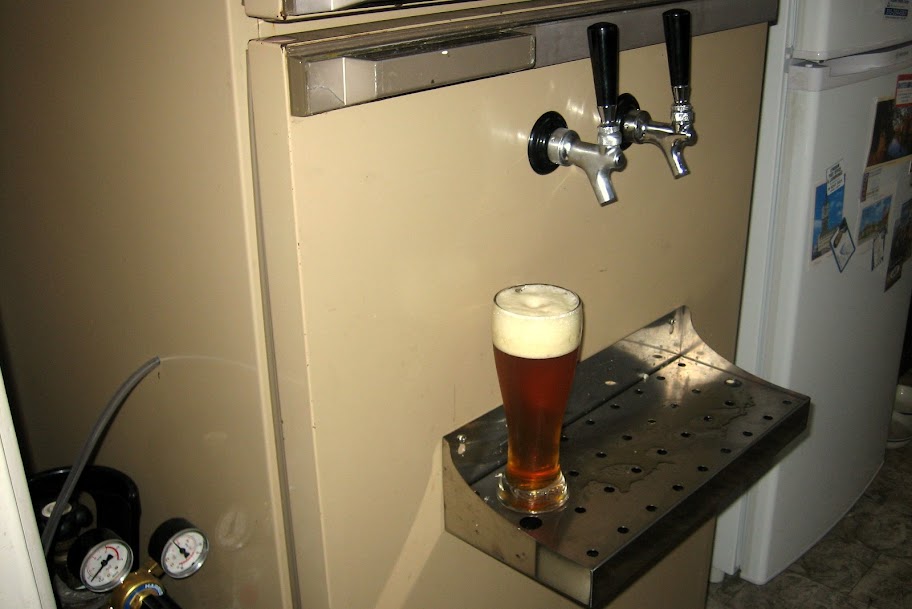
Mixy helped me install a second tap today. Currently pouring is a two-row lager (brew 76) on the left tap and a pilsener (brew 75) on the right.
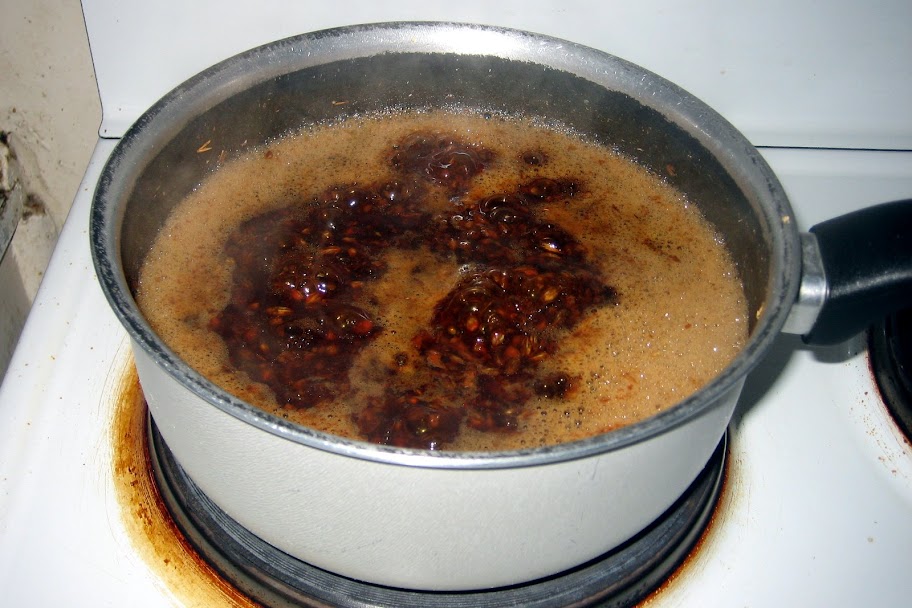
I also started brew 79, a red lager. This recipe called for cracked crystal malt grain. A picture of this grain, on a roiling boil, is shown below. It made the house smell wonderful!
Brew 77
I brewed and then kegged another batch of my popular Hoegaarden mimic. It smells spicy and fruity just like the original. The alcohol concentration has concluded at about 3.4% (v/v), or 1.1 standard drinks per schooner. (The genuine article is produced at about 5.0%, or 1.7 standard drinks per schooner.) The fermentation record is presented graphically below.
Brew 77 ingredients:
- Black Rock "Whispering Wheat", 1.7kg
- Morgan's "Wheat Malt", 1.0kg
- Cracked coriander seeds, 50g
- Zest of one orange
- Safbrew WB-06 yeast, 11.5g
The total volume was 23L. Original and final gravity readings were 1.034 and 1.008 g/mL, respectively.
News flash from Sunday 12 Oct 2008:
We tapped the keg on Friday and indulged ourselves and a bunch of (I think) satisfied chemists in the evening. A sip on Saturday and a couple on Sunday and the keg was gone. In two days! I will have to make a clone again very soon. I would really like a 60L fermenter sometimes.
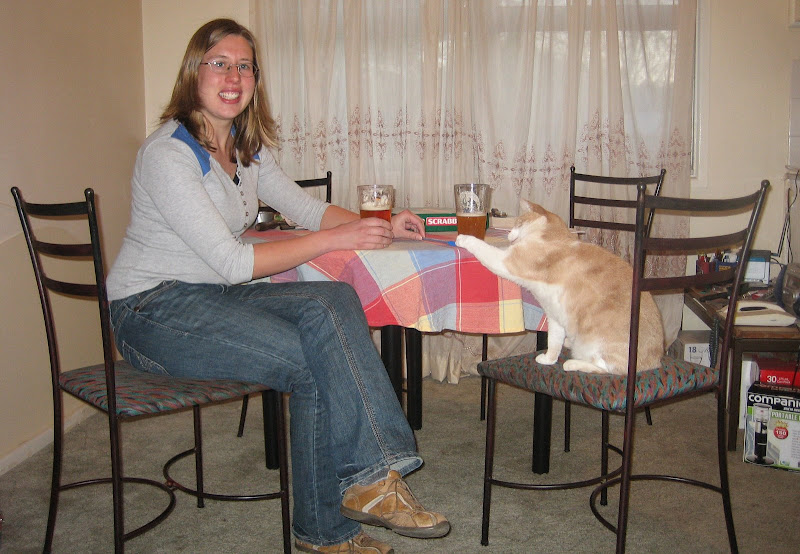
Jenny and Puss are sharing a couple of Hoegaardens on Saturday afternoon.
Thursday, October 2, 2008
Inspiration
I am trying to think of the next double up to go and I need a bit of help trying to decide. I would like a beer that is reasonably palette friendly but not too subtle in flavour compared to our mass producers. I would like a simple yet easily drinkable with robust flavour. Please lend me your input.
Subscribe to:
Posts (Atom)
